Discover volcanoes, wildlife, wetlands and living Aymara culture across the highlands of Northern Chile
Culture · Wildlife · Volcanoes · High-Altitude Landscapes
WHERE THE EARTH MEETS THE SKY
In the far north of Chile, the Andes rise into a landscape of immense distances, volcanic peaks, high-altitude wetlands and deep blue lakes.
This is the Lauca Biosphere Reserve — a vast Andean territory where nature and culture have evolved together for centuries.
At first glance, Lauca can seem almost empty.
The horizon is wide. Vegetation is sparse. Roads disappear into the highlands, and the silence can feel absolute.
But look closer.
A vicuña moves across a bofedal. Flamingos gather in a shallow lagoon. A condor circles above a volcanic ridge. Cushion plants cling to rocky ground, while ancient queñoa trees survive at elevations where forests seem almost impossible.
And beyond the wildlife, there is another layer to the landscape.
People live here.
Aymara communities continue to maintain relationships with the land, animals, water and mountains that form this high-altitude territory.
Lauca is not simply a landscape to admire. It is a landscape to understand.
A BIOSPHERE RESERVE, NOT JUST A NATIONAL PARK
One of the first things worth understanding about Lauca is its scale.
The Lauca Biosphere Reserve covers more than one million hectares, extending across the communes of Putre, General Lagos and Camarones in Arica and Parinacota, close to the borders with Bolivia and Peru.
Within this territory are several protected areas, including Lauca National Park, Las Vicuñas National Reserve and Salar de Surire Natural Monument.
This distinction matters.
A national park is a protected area.
A biosphere reserve is something broader: a territory designed to connect conservation, human communities, research, education and sustainable development.
That is why travelling through Lauca is not simply about ticking off viewpoints.
It is about moving through a much larger living system.
THE ALTITUDE CHANGES EVERYTHING
One of the first things a visitor notices in Lauca is not something they can see.
It is the air.
Large areas of the reserve lie above 4,000 metres, where the combination of altitude, intense solar radiation, dry air, wind and rapid temperature changes creates demanding conditions for both people and wildlife. CONAF specifically recommends hydration, slow walking and avoiding sudden physical exertion when visiting Lauca.
For travellers arriving from sea level, the difference can be significant.
A short walk may feel harder than expected.
A gentle slope can raise your breathing rate.
And distances across the open Altiplano are notoriously difficult to judge.
This is why travelling in Lauca requires a different rhythm.
You do not rush the Altiplano.
You allow the body to adapt, walk steadily and give yourself time to observe.
That slower rhythm is not a limitation.
It is part of discovering the territory.
A LANDSCAPE BUILT BY VOLCANOES
The geological character of Lauca is impossible to ignore.
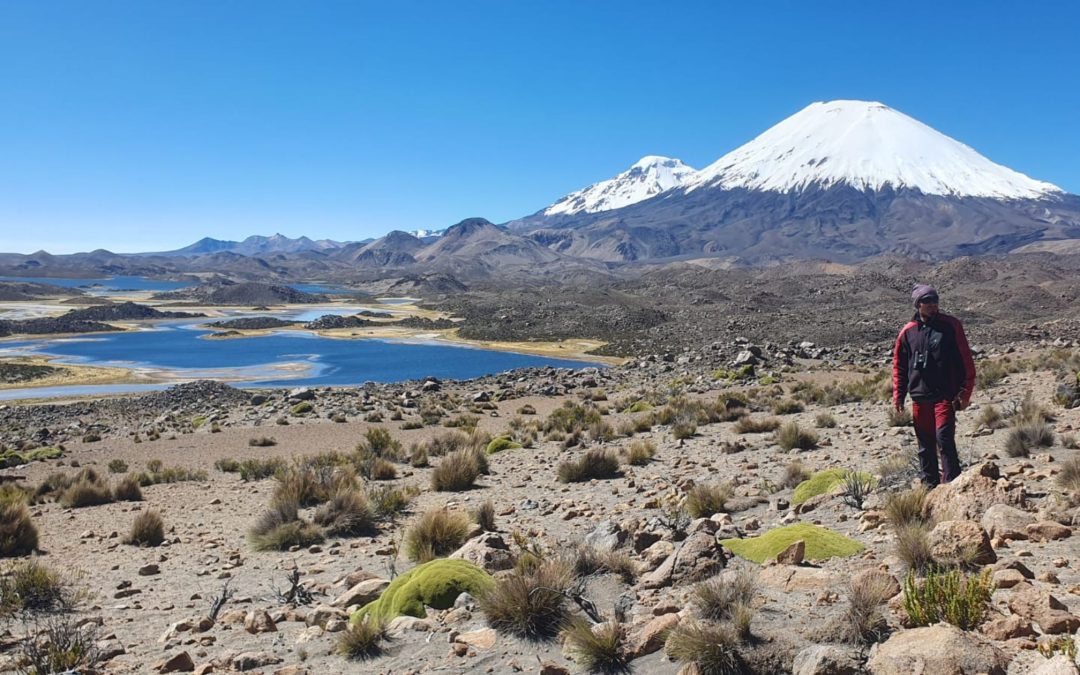
Volcanoes dominate the skyline, while lava formations, high plateaus, volcanic lakes and mineral-rich soils reveal the forces that have shaped the Andes over geological time.
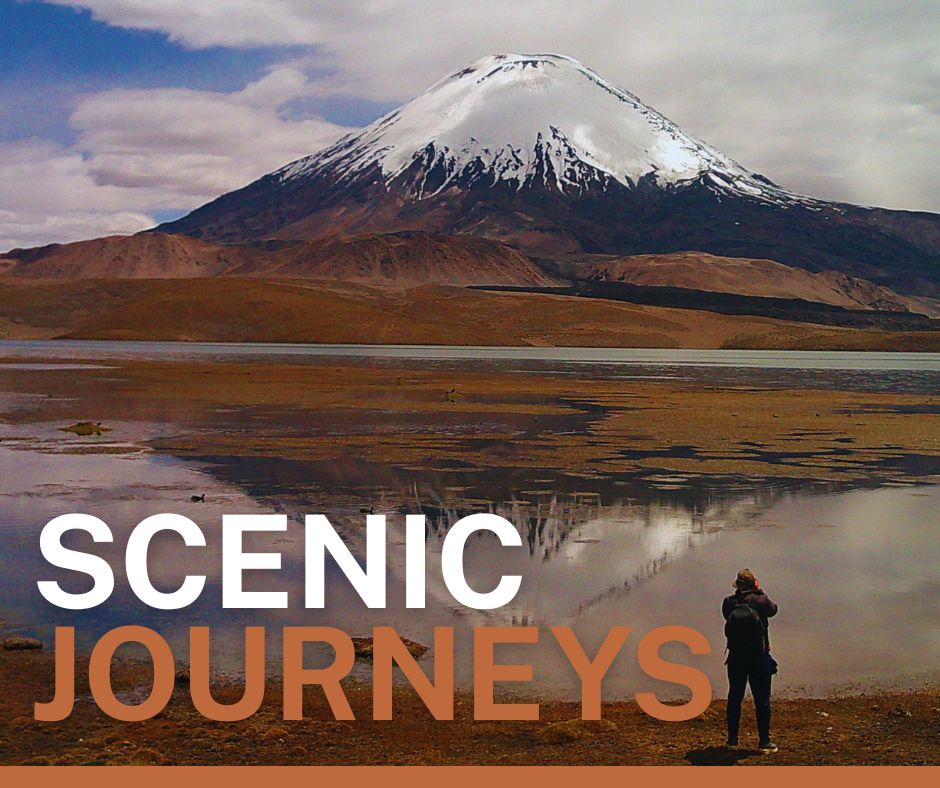
Among the best-known landmarks are Parinacota and Pomerape, the twin volcanoes of the Payachatas, together with the broader volcanic landscape surrounding Lake Chungará and the Cotacotani lagoon system.
But Lauca is not only about dramatic peaks.
Its real character emerges from the relationship between mountain, water and altitude.
At high elevations, water becomes precious.
Where it remains available, life concentrates.
That is where bofedales — high-Andean wetlands — become essential.
WHERE WATER CREATES LIFE
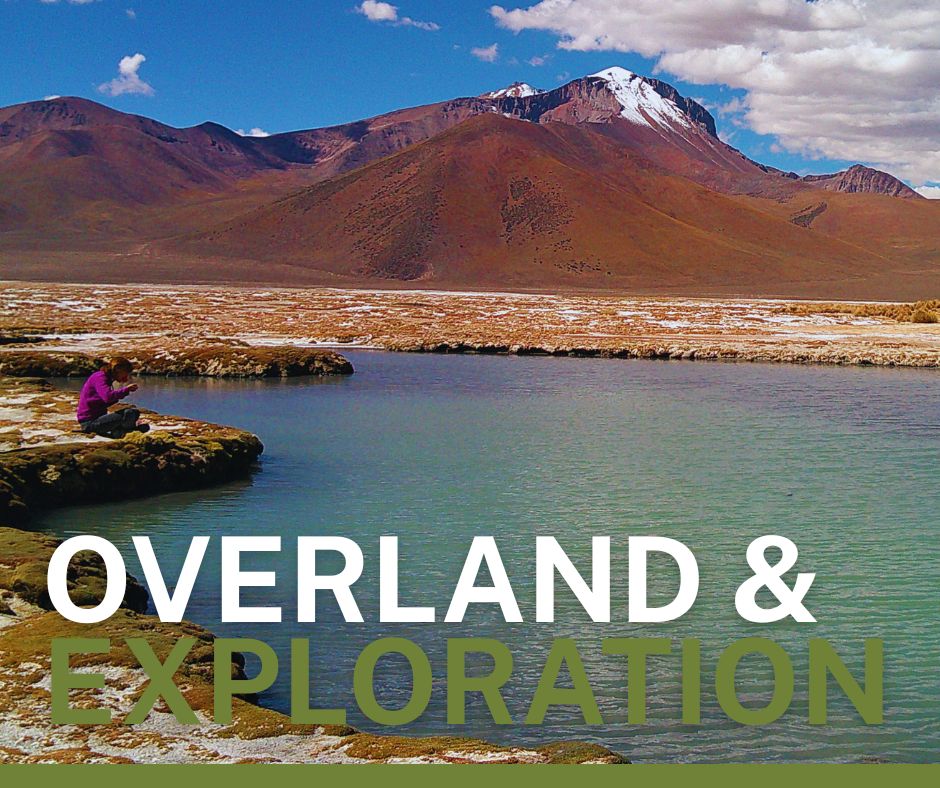
In an environment that can appear almost desert-like, wetlands are among the most important ecosystems in the Altiplano.
Bofedales are wet areas where specialized plants form dense vegetation capable of surviving under cold, high-altitude conditions.
They provide food and water for herbivores and become important habitats for birds and other wildlife.
CONAF identifies several characteristic plant communities in Lauca, including high-Andean grasses, bofedales, cushion plants and queñoa woodlands.
One of the most remarkable plants is the llareta (Azorella compacta), a compact cushion-forming plant adapted to extreme environments.
Another is the queñoa de altura (Polylepis tarapacana), one of the world’s highest-growing tree species, found in rocky high-altitude environments of the Andes.
These plants tell an important story.
Life in Lauca is not abundant because conditions are easy.
It is abundant because life here has learned how to adapt.
WILDLIFE AT THE EDGE OF SURVIVAL
The fauna of Lauca is one of the reserve’s greatest attractions.
And this is where travelling slowly begins to make sense.
Vicuñas can often be seen moving across the open plains. Vizcachas occupy rocky slopes. And with patience, travellers may encounter foxes, guanacos or, much more rarely, signs of larger predators such as the puma.
The reserve is also remarkable for its birdlife.
CONAF records more than 60 bird species in Lauca National Park, including Andean flamingos, Chilean flamingos, suris, puna partridges and guallatas. Mammals include vicuñas, guanacos, tarucas, pumas and vizcachas.
UNESCO describes Lauca as one of the areas in Chile with particularly high bird diversity.
For wildlife enthusiasts, this creates an unusual experience:
There is no need for a traditional safari vehicle or dense forest.
Here, wildlife is discovered across open horizons.
The challenge is learning how to see.
THE VICUÑA AND THE AYMARA TERRITORY
Perhaps nowhere is the connection between nature and culture more visible than in the relationship between Aymara communities and the vicuña.
For generations, the vicuña has been part of the ecological and cultural landscape of the Altiplano.
Today, community-based conservation is helping revive traditional practices connected with the sustainable management of these animals.
In 2025, UNESCO documented a community-based initiative in Lauca involving the traditional chaku, an Aymara practice of gathering and shearing vicuñas, combining cultural knowledge, wildlife management and sustainable livelihoods.
This is an important story because it challenges the idea that conservation simply means keeping people away from nature.
In Lauca, conservation can also mean strengthening the knowledge of people who have lived with this landscape for generations.
That relationship is part of what makes the reserve different.
A LIVING AYmara LANDSCAPE
The cultural landscape of Lauca is not a museum.
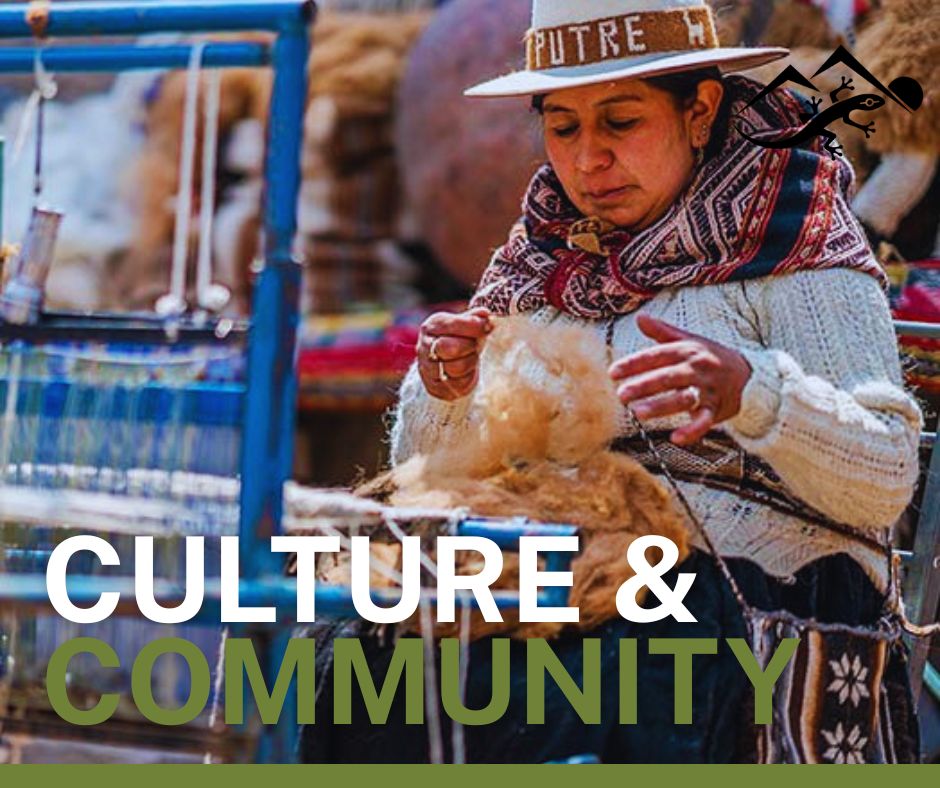
Aymara communities continue to live across the highlands, maintaining traditions, agricultural practices, livestock systems, ceremonies and relationships with the territory.
The landscape itself carries traces of this history.
Villages, agricultural terraces, paths, chapels, fields and pasturelands appear within a territory that can initially seem completely wild.
This is one of the most important things a visitor can learn here:
The absence of dense urban development does not mean the absence of human history.
The Altiplano has been travelled, inhabited and cared for for generations.
When we enter this territory, we are not entering an empty wilderness.
We are entering a living cultural landscape.
THREE WAYS TO DISCOVER LAUCA
Lauca reveals itself differently depending on how you travel.
WALK
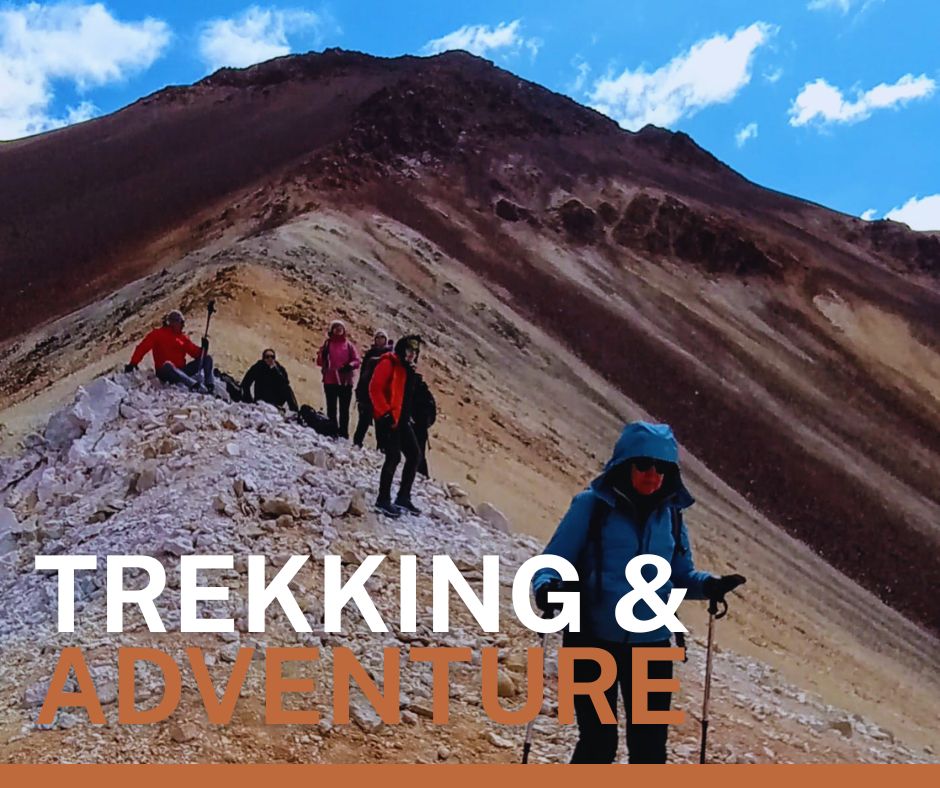
Trekking slows everything down.
A trail allows you to notice changes in vegetation, animal tracks, rock formations, water and altitude that can easily disappear from a vehicle window.
OBSERVE
Wildlife requires patience.
Stop.
Look across the bofedal.
Scan the slopes.
Watch the movement of birds.
The most memorable encounters are often the ones you did not expect.
CONNECT
Meeting local communities adds another layer to the journey.
Through conversation, food, traditional knowledge, textiles, pastoral practices or interpretation of the landscape, visitors can begin to understand that the Andes are not simply scenery.
They are territory.
LAUCA’S PLACES OF DISCOVERY
The reserve contains an extraordinary concentration of landscapes within a relatively compact region.
LAKE CHUNGARÁ
At more than 4,500 metres, Lake Chungará is one of the world’s highest navigable lakes and one of the iconic landscapes of Lauca.
Its waters reflect the Payachatas volcanoes, creating one of the defining views of the Chilean Altiplano.
CONAF describes the lake as an important site for observing a diversity of bird species, including resident and migratory birds.
LAGUNAS DE COTACOTANI
A complex system of lagoons surrounded by volcanic terrain, Cotacotani offers a different perspective on the relationship between water and geology.
The colours and reflections change throughout the day, making it one of the reserve’s most compelling landscapes for photography and walking.
SALAR DE SURIRE
Further into the highlands, Surire presents an entirely different environment.
Salt, wetlands, mountains and flamingos converge in a landscape where the apparent emptiness becomes one of its greatest strengths.
The Salar de Surire Natural Monument forms part of the Lauca Biosphere Reserve and protects an important habitat for three species of flamingo.
PUTRE & THE PRECORDILLERA
The journey into Lauca does not begin at 4,500 metres.
Putre, located in the precordillera, is an important gateway to the highlands.
The gradual transition from lower valleys into the Altiplano is itself part of the experience.
The journey upward is part of discovering Lauca.
WHEN TO LOOK CLOSER
The most rewarding moments in Lauca are often not the obvious ones.
A flock of flamingos moving across a lagoon.
The silhouette of a vicuña against a volcanic slope.
A patch of bofedal surrounded by dry terrain.
The geometric terraces around an Andean settlement.
The first snow appearing on a volcano after an afternoon storm.
Or the sudden realization that a seemingly barren slope is covered with tiny plants adapted to one of the most demanding environments on Earth.
Lauca rewards attention more than speed.
And perhaps that is the best way to experience it.
TRAVELLING THROUGH LAUCA WITH RESPECT
A high-altitude ecosystem can look resilient because it is vast.
But it is also fragile.
When travelling through the reserve, stay on appropriate routes, follow protected-area regulations, avoid disturbing wildlife and respect local communities and their territories.
At these elevations, even small changes in weather can affect conditions quickly.
And because much of the reserve lies above 4,000 metres, acclimatization and responsible pacing should be considered part of the itinerary rather than an afterthought.
Travel lightly. Observe carefully. Leave the landscape as you found it.
DISCOVER THE LAUCA BIOSPHERE RESERVE
Lauca is not a destination that can be understood in a single photograph.
It is a territory of contrasts:
volcanoes and wetlands,
salt flats and forests,
wildlife and human presence,
extreme altitude and extraordinary adaptation.
To travel through the reserve is to move through several layers of the Andes at once.
The geological story is written in the volcanoes.
The ecological story is visible in the bofedales and wildlife.
The cultural story lives in the communities and traditions of the Altiplano.
And the traveller becomes part of the story simply by slowing down enough to see it.
This is Lauca.
Not just a place to visit.
A landscape to discover.
EXPERIENCE THE LIVING ANDES
Discover Northern Chile through journeys that connect landscapes, wildlife and living Andean culture.
EXPLORE LAUCA →